Training and the Knowledge Cutoff
Training shapes a model's parameters before deployment; prompts and retrieved evidence shape a response at runtime without rewriting those parameters.
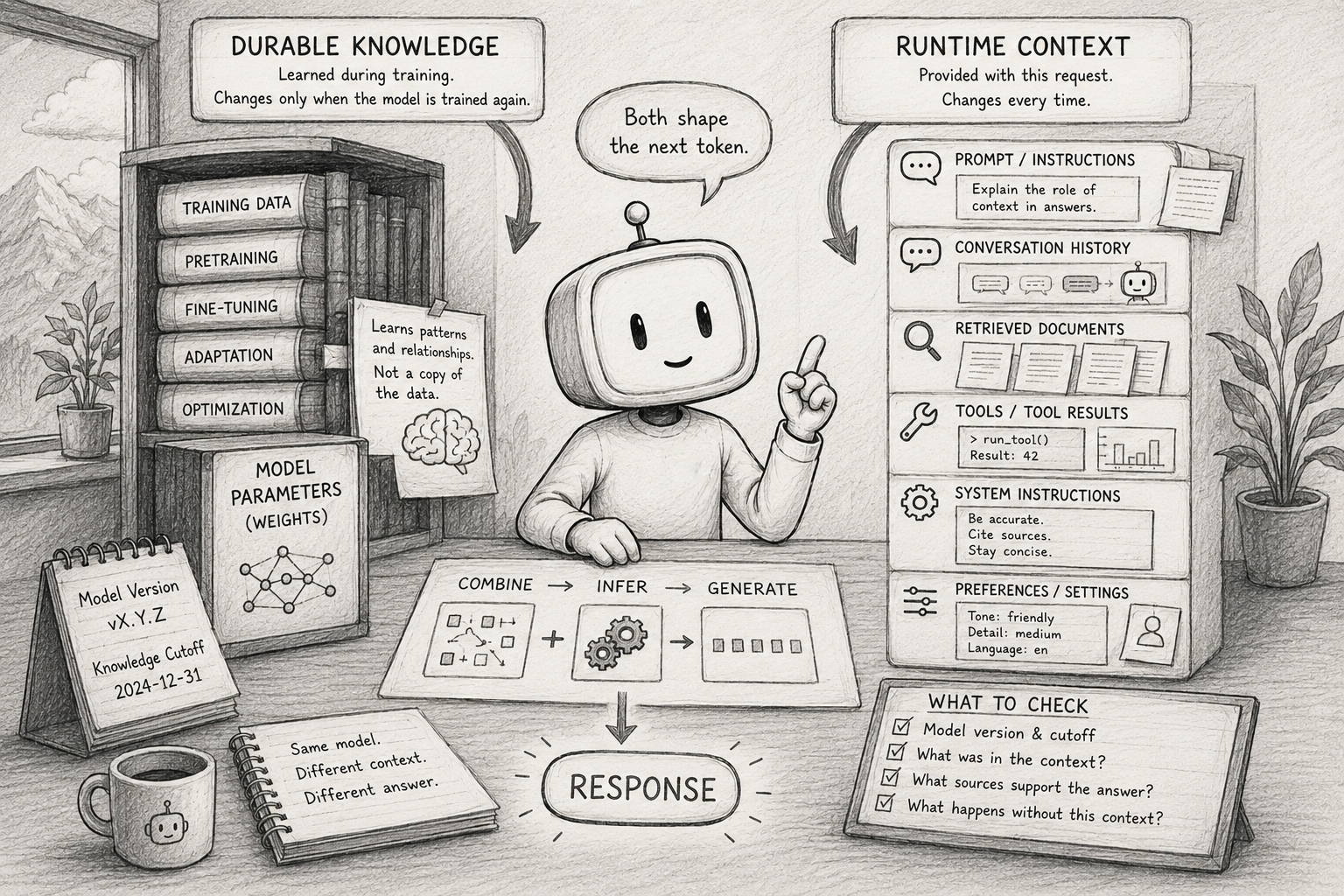
A language model can answer a question from two very different kinds of information. Some patterns are encoded in the model’s parameters during training. Other information arrives with the current request: instructions, conversation history, retrieved documents, or tool results.
Both can influence the next token. They do not change the model in the same way.
That distinction explains what a knowledge cutoff means, why a correction can improve the rest of one conversation, and why a fresh conversation may lose that correction entirely.
Two paths into an answer
For a fixed model version, it helps to separate a durable path from a runtime path:
training data + optimization
            -> model parameters
            -> versioned model

prompt + prior turns + retrieved evidence
            -> current context
            -> inference with that versioned model
            -> response
The first path changes the numerical state used by the model. The second supplies information to one inference process. A response depends on both the existing parameters and the context available for that call.
The diagram is a working model, not a claim that every AI product has the same architecture. Applications can add memory stores, retrieval systems, tools, routing, and model adaptation. The important question is still: did this operation change durable model state, or did it provide temporary input?
What training changes
During training, an optimization process adjusts a large collection of parameters, often called weights. The process repeatedly compares model output with a training objective and updates those parameters to reduce error across many examples.
The result is not a searchable archive of the training corpus. It is a learned numerical state that captures patterns useful for producing future output. A model can reproduce some facts and relationships from those patterns, fail to recall others, or combine them in ways that were never present as one stored passage.
Pretraining is not the only way parameters can change. Fine-tuning and other adaptation methods can also create a new durable model state. Those are explicit training-time operations with their own data, configuration, and resulting model version.
An ordinary prompt to a fixed deployed model is different. The prompt affects the computation being performed, but a better answer after a correction is not evidence that an optimization step rewrote the base model’s parameters.
What context changes
At inference time, the model generates from the token sequence available now. That sequence can contain more than the visible question. Depending on the application, it may include:
- system instructions,
- earlier messages replayed into the request,
- retrieved passages,
- tool descriptions and results,
- application-managed preferences or summaries.
Adding a fact to this context can change the next-token distributions throughout the response. The effect can be strong enough to look like learning: correct the model once, and later answers in the same thread may use the correction.
The causal chain is narrower:
- The correction becomes part of the current context.
- Later generation is conditioned on that expanded context.
- The output changes while the correction remains available.
- Remove that context, and the same influence may disappear.
This is in-context conditioning. It does not demonstrate a durable parameter update.
What a knowledge cutoff tells you
A provider may publish a knowledge cutoff for a particular model version. The date marks a boundary on the native training knowledge the provider documents for that model. It is useful operational metadata, but it is easy to ask it to prove too much.
A cutoff does not mean:
- every event before the date is represented in the model,
- every represented fact can be recalled reliably,
- the model becomes unable to reason about anything that happened later,
- a post-cutoff claim is false,
- a pre-cutoff answer is verified.
Instead, use the cutoff as one part of an evidence decision. For a factual question, ask two separate questions:
- Could the information plausibly fall within the model’s documented native-knowledge period?
- Is suitable evidence available in this request?
The first question concerns possible model knowledge. The second concerns support for this answer. Only the second can show what evidence the current response had available.
A release after the cutoff
Suppose a model declares a cutoff of December 31, 2024. A software framework releases a breaking API change on March 15, 2025.
Ask the ungrounded model how the new API works and it may decline, mix old and new behavior, or produce a fluent answer that sounds current. The cutoff gives you a reason not to assume that answer came from reliable native knowledge.
Now let the application retrieve the official release notes and place the relevant section into the request. The model can generate an answer conditioned on that evidence. No base-model retraining is required for the evidence to affect the response.
What changed was the information path:
official release notes -> current context -> answer about the new APIThe answer is now grounded in a source available to this call. That improves its evidentiary position, but it does not guarantee correctness. Retrieval can select the wrong passage, the source can be incomplete, and the model can misread or overextend what the passage says.
Why a fresh conversation is a useful test
Imagine correcting a model about the framework change, then asking a follow-up question in the same thread. If the application includes the correction in subsequent requests, the model can use it.
Open a fresh conversation with the same model version and remove any application-managed memory or hidden retrieval. The correction is no longer in context. You should not expect the new call to preserve it reliably.
This comparison isolates the mechanism. It does not tell you whether a provider stores conversations, uses them for future training, or offers personalization. Those are separate product and data-policy questions. The claim here is limited to the current inference: a prompt influencing output does not, by itself, show that the base model’s parameters changed.
Common misconception
“The model learned that from my correction.”
The model may have used the correction effectively. In a normal call to a fixed model snapshot, the direct explanation is that the correction entered the runtime context and changed generation. Durable learning requires a separate mechanism that updates or supplements state beyond that request.
The engineering habit
When current or high-stakes facts matter, do not infer provenance from a polished answer. Inspect the system around the model:
- Which model version handled the request?
- What cutoff does its provider document?
- What prompt, history, and retrieved material entered the context?
- Which source supports each consequential claim?
- What should happen when the same question is asked without that context?
This separates three questions that are often collapsed into one: what patterns the model acquired during training, what evidence the application supplied at runtime, and what the response can actually justify.
References
- Language Models are Few-Shot LearnersNeurIPS, 2020
- Retrieval-Augmented Generation for Knowledge-Intensive NLP TasksNeurIPS, 2020
- GPT-4.1 model documentationOpenAI